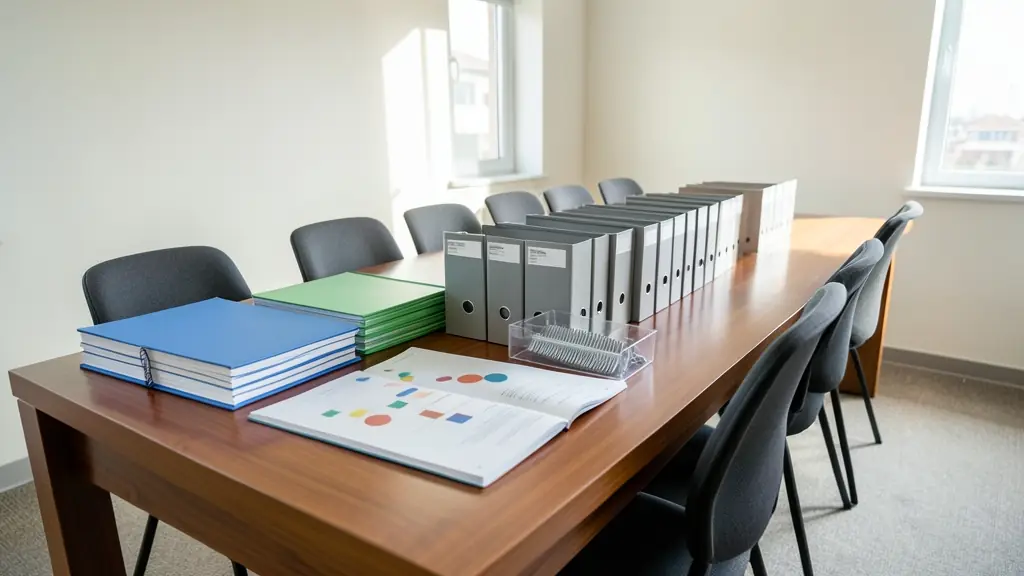
Corporate training materials are what learners hold in their hands: the learner guide, the workbook, the assessment guide and the portfolio of evidence file, with a facilitator guide that keeps every trainer on the same script. Good materials match the course outcomes, use plain language and survive being carried around a site for weeks. Tell us what you need written, updated or printed, the quantities and the delivery date, and we pass your request to independent instructional designers and training printers in your area, who quote you directly. The request is free.
The documents in a training pack
- Facilitator guide: the timing, activities, key points and answers, so different trainers deliver the same course
- Learner guide: the content, examples and space for notes
- Workbook: exercises and case studies used in class
- Assessment guide: the tasks and the memo or marking guide for the assessor
- PoE file: the portfolio of evidence the learner completes and the assessor and moderator check
Writing and instructional design
An instructional designer starts from the outcomes, or for an accredited programme from the qualification, unit standard or curriculum, then plans the activities and assessments before writing. Ask about plain language, examples that fit South African workplaces, and translation or summaries in the languages your learners use. If the course is for a learnership or a SETA funded programme, ask the provider what the accrediting body needs in the materials. Own the content you pay for: agree in writing who holds the copyright.
Printing and binding
Training printers usually offer:
- Wire binding: lies flat, good for workbooks used at a desk
- Comb binding: lower cost, can be opened to add pages
- Lever arch or ring binders: for PoE files that grow during a course
- Colour or black and white, card covers and dividers, tabs and plastic sleeves
Ask for a proof copy before the full run, and print in batches if the course changes often.
Delivery and keeping them current
Ask for delivery to the office or to each training venue, packed per group. Keep version numbers on every guide, update them when laws, systems or procedures change, and collect learner feedback through training evaluation to see which sections need rewriting.
For a site with no reliable printer nearby, such as a mine, a farm or a rural school, order the full set early and ask the printer to courier it in boxes marked per group. Keep the master files in an editable format with a named owner in the business, so the next update does not start from a scanned copy. Where learners have limited reading time, short sections, clear headings, diagrams and worked examples usually help more than long pages of text.
What to include in your brief
- The course and how long it is
- Writing, updating or printing only
- How many learners and facilitators
- Binding: wire, comb or lever arch files
- Delivery date and venue
Training Materials for business, government and communities
- Companies and head offices: induction, compliance and systems training packs printed for each intake
- Government departments and municipalities: workshop packs and learner guides for departmental training programmes
- Schools, colleges and universities: staff development workbooks and guides for TVET and school programmes
- NPOs, churches and community groups: simple workbooks for youth and community skills programmes
- Small and family businesses: a short induction guide and a product manual for new staff
- Mines, plants, factories and farms: safety and operator training guides that survive a site environment
- Event organisers and associations: delegate packs and workbooks for a conference or masterclass
- Training and skills development providers: learner guides, assessment guides and PoE files for accredited courses
Frequently asked questions
Do you write or print training materials yourselves?
Can I get materials for an accredited course?
How many copies should I print?
What does it cost to have training materials written?
Training Materials by province and city
- Johannesburg
- Pretoria
- Centurion
- Midrand
- Sandton
- Randburg
- Roodepoort
- Krugersdorp
- Randfontein
- Germiston
- Boksburg
- Benoni
- Kempton Park
- Alberton
- Vanderbijlpark
- Vereeniging
- Durban
- Pinetown
- Pietermaritzburg
- Richards Bay
- Newcastle
- Ladysmith
- Gqeberha (Port Elizabeth)
- East London
- Kariega (Uitenhage)
- Mthatha
- Cape Town
- Bellville
- Paarl
- Stellenbosch
- George
- Worcester
- eMalahleni (Witbank)
- Middelburg
- Secunda
- Mbombela (Nelspruit)
- Rustenburg
- Brits
- Klerksdorp
- Potchefstroom
- Mahikeng
- Polokwane
- Tzaneen
- Kimberley
- Upington
- Bloemfontein
- Welkom
- Sasolburg