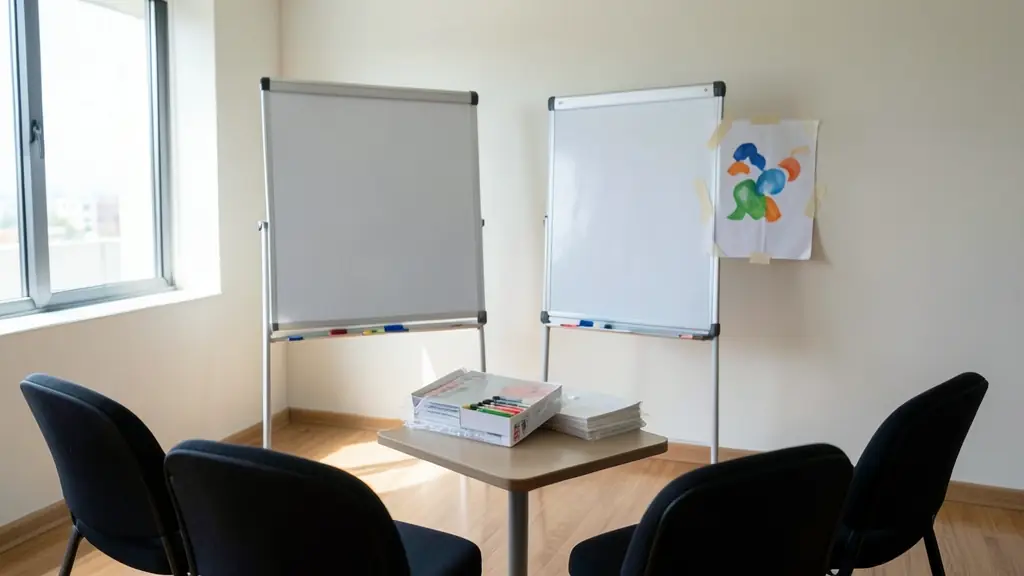
A flip chart is still the most used tool in most training rooms and workshops: it needs no power, works during load-shedding and lets a group see its own thinking on the wall. Getting it right means the right pads, a stand that does not wobble and markers that do not bleed onto the next sheet. Tell us what you need, how many pads, stands or markers and where to deliver, and we pass your request to independent stationery and office suppliers in your area, who quote you directly. The request is free.
Flip chart paper: sizes and rulings
Flip chart pads are usually about A1, glued or punched at the top to fit an easel. Most come with 25 to 50 sheets, plain, squared (grid) or lightly ruled. Plain paper suits drawing and graphic facilitation; squared paper helps a facilitator write straight and draw tables and timelines. Heavier paper resists bleed-through and tearing when sheets are stuck to walls. Some pads have adhesive strips so sheets hang without tape, which helps at venues that do not allow masking tape on paint.
Stands, easels and mobile boards
A tripod stand is light and folds into a car boot, good for a trainer who moves between venues. A mobile easel on castors with a whiteboard surface is steadier and lets you write on the board or on paper, useful in a permanent training room. Check:
- The height adjusts for shorter and taller facilitators
- The clamp or pegs fit the pad you buy
- The legs lock, so the stand does not fold mid-session
- Side arms, if you want to hang two sheets at once
For bigger boards see whiteboards.
Markers that do not bleed
Use water based or low odour alcohol based flip chart markers on paper, with a chisel tip for thick, readable lines from the back of the room. Permanent markers bleed through to the next sheet and onto walls. Dry-erase markers are for whiteboards, not paper. Dark colours (black, blue, green, brown) read best; keep red and orange for highlights. A full set per table makes group work easier, and a workshop kit can bundle markers with sticky notes and masking tape.
Buying in bulk, or hiring for an event
Training providers, schools and companies that run sessions every week often buy pads by the box, which usually brings the price per pad down. Ask about delivery to the office or straight to the venue. For a one-off conference with many breakout rooms, some AV and event suppliers hire out stands and include pads, and many conference venues supply one flip chart per room. Ask how many pads come with it. If the session is out of town at a lodge or guest farm, order the pads with your other supplies and have them delivered with time to spare, as small towns may not stock A1 pads.
What to include in your brief
- How many pads, plain or squared
- Tripod stands or mobile easels, and how many
- Markers: colours and how many sets
- Once-off event or a regular order
- Delivery address and the date needed
Flip Charts and Flip Chart Paper for business, government and communities
- Companies and head offices: pads and mobile easels for in-house training rooms and strategy days
- Government departments and municipalities: flip charts for departmental workshops, imbizos and APP planning sessions
- Schools, colleges and universities: pads and stands for classrooms, staff development days and learner programmes
- NPOs, churches and community groups: low-cost pads and markers for community workshops and NPO planning days
- Small and family businesses: a single stand and a few pads for team meetings and sales planning
- Mines, plants, factories and farms: sturdy stands for safety talks and toolbox sessions at a plant or mine
- Event organisers and associations: stands for every breakout room at a conference, hired or bought
- Training and skills development providers: pads by the box for weekly courses, delivered to each training venue
Frequently asked questions
Do you sell flip charts yourselves?
How many flip chart pads do I need for a workshop?
What is the standard flip chart paper size?
Can the supplier deliver straight to the venue?
Flip Charts and Flip Chart Paper by province and city
- Johannesburg
- Pretoria
- Centurion
- Midrand
- Sandton
- Randburg
- Roodepoort
- Krugersdorp
- Randfontein
- Germiston
- Boksburg
- Benoni
- Kempton Park
- Alberton
- Vanderbijlpark
- Vereeniging
- Durban
- Pinetown
- Pietermaritzburg
- Richards Bay
- Newcastle
- Ladysmith
- Gqeberha (Port Elizabeth)
- East London
- Kariega (Uitenhage)
- Mthatha
- Cape Town
- Bellville
- Paarl
- Stellenbosch
- George
- Worcester
- eMalahleni (Witbank)
- Middelburg
- Secunda
- Mbombela (Nelspruit)
- Rustenburg
- Brits
- Klerksdorp
- Potchefstroom
- Mahikeng
- Polokwane
- Tzaneen
- Kimberley
- Upington
- Bloemfontein
- Welkom
- Sasolburg